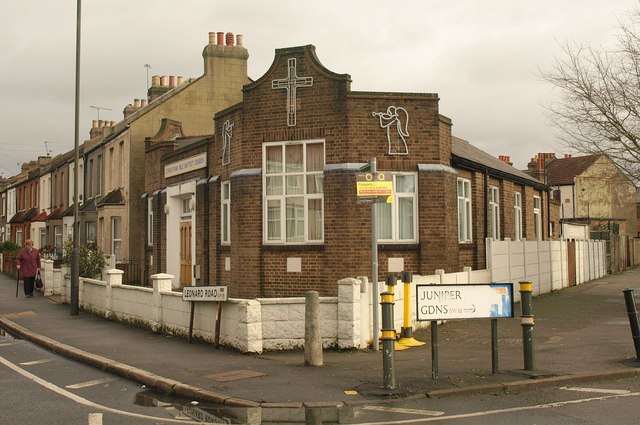
Streatham Vale Baptist Church on the corner of Leonard Road and Juniper Gardens, January 2011. Photo © Derek Harper, CC BY-SA 2.0
Streatham Vale Baptist Church is a daughter church of Streatham Baptist Church on Lewin Road. For well over a century, Baptist Christians have been meeting on Leonard Road to worship God, teach children about Jesus and serve the people who live around them.
This page is a work in progress. If you have memories, photographs, old church magazines or documents, we would love to hear from you. See Help us tell the story below.
Key dates
| Year | What happened |
|---|---|
| 1866 | Streatham Baptist Church is formally constituted as a Baptist congregation. |
| 1877 | Streatham Baptist builds its first chapel, on Lewin Road. |
| 1887 | Streatham Baptist builds an iron mission hut on Leonard Road, in the hamlet of Lonesome. |
| 1901–02 | The Lewin Road chapel is rebuilt to designs by the architect George Baines. |
| 1922 | A local newspaper describes children walking to “the iron mission hall” in Lonesome for Sunday school. |
| 1924–1930s | The Streatham Vale estate is built around the old hamlet. The Baptist Mission Hall on Leonard Road serves the new community. |
| 1944 | V-1 flying bombs damage 154 houses in Streatham Vale. |
| 1989 | Merton’s local archive photographs the church building on Leonard Road. |
| Today | Streatham Vale Baptist Church is part of London Baptists and the Baptist Union of Great Britain. |
Our mother church: Streatham Baptist
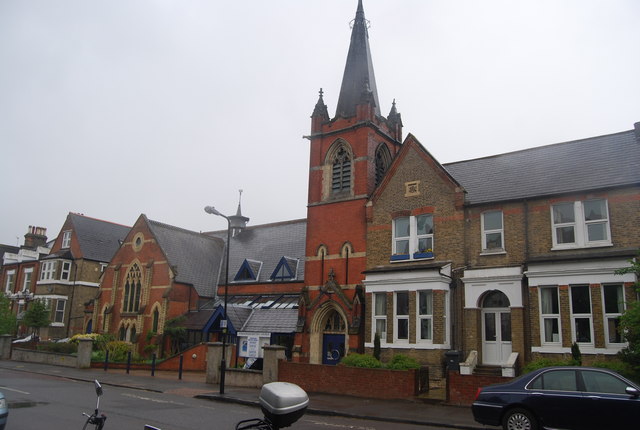
Streatham Baptist Church, Lewin Road, our mother church, in May 2010. Photo © N Chadwick, CC BY-SA 2.0
Streatham’s Baptists began with very little. Before they had a building, they worshipped in a small wooden hut on wheels, which could be moved around the parish for services.1 In 1866 they became an official Baptist congregation.2 In 1877 they built a brick chapel on Lewin Road,3 the first Baptist chapel in the ancient parish of Streatham.4 Between 1901 and 1902 the chapel was replaced by the larger church designed by George Baines that still stands today.5 Its members still affectionately call it “Lewin”.6
Streatham Baptist was a church with a heart for mission. Within ten years of opening its first chapel, it had planted an outpost in one of the most isolated corners of the district.
Lonesome
Before the 1920s, the land around Leonard Road was known, aptly, as Lonesome. It was a remote corner of Mitcham parish, on the border with Streatham, and was reached by a muddy track called Lonesome Lane, which is now Streatham Vale.7
Lonesome was not a pretty village. Its neighbours included a chemical works making pigments and solvents for the rubber industry, brickfields and market gardens,8 a slaughterhouse,9 lavender fields and Pain’s fireworks factory.10 Nearby stood “Blake’s Follies”, a double row of large houses built as a speculation that never found tenants. Newspapers of the early 1900s ran articles about this “deserted village” that hardly anyone in London had heard of.11 The people who did live there occupied humble terraced cottages in Leonard, Lilian and Marian Roads.12
The iron mission hut (1887)
In 1887, Streatham Baptist Church built a mission hall in Leonard Road. It was an iron “tin tabernacle” with a match-boarded interior that could seat about 100 people.13 Corrugated-iron chapels like this were cheap, quick to put up and common in growing districts. They let churches reach new communities long before they could afford a permanent building.
A few years later, in 1906, the Church Army opened a second iron mission nearby, the Anglican Good Shepherd Mission Room off Lilian Road.14 For a while, Lonesome had two tin missions within a few streets of each other.
On a Sunday morning in February 1922, a writer for the Streatham News walked through Lonesome and described the scene:
“Humble to a degree, these homes, yet not without pride to the dwellers, many of whom were out furbishing frontages. Toddling youngsters made their way to the iron mission hall for Sunday school.”15
We can’t be certain which of the two mission halls those children were heading for.16 But for over thirty years, Sunday school was a central part of life at the Leonard Road mission.
A new suburb: Streatham Vale
From 1924, Lonesome changed almost beyond recognition. The builders R. H. Miller and Wates laid out the Streatham Vale estate,17 and by 1928 nearly 2,000 new homes had been built.18 Blake’s Follies were demolished in 1927–28,19 and new schools, shops and churches followed. The Holy Redeemer parish church opened in 1932, and the Salvation Army opened a hall at Lonesome in 1930. The history of the Streatham Vale Property Owners’ Association records that, alongside these, there was “a Baptist Mission Hall in Leonard Road”.20
The mission that had served a small and isolated hamlet now found itself in the middle of a busy new suburb, full of young families.
War and after
Streatham Vale suffered badly in the Second World War. In 1944, V-1 flying bombs damaged 154 houses on the estate, and whole blocks were destroyed.21 We don’t yet know how the mission hall and its congregation fared during the war.
At some point the mission grew from an outpost of Lewin Road into the church we know today, Streatham Vale Baptist Church, and the present brick building on the corner of Leonard Road and Juniper Gardens was built. Its gable carries a raised cross, and an angel in relief sits on the corner. We are still researching when these things happened. The building was photographed for Merton’s local archive in 1989.22
Today
Streatham Vale Baptist Church is a small, welcoming church and a member of London Baptists and the Baptist Union of Great Britain.23 The church still stands in the same streets where the tin mission hut stood more than 135 years ago. Children’s ministry, care for neighbours, and bringing the Love, Hope and Joy of God to the community are still at the heart of what we do.
Help us tell the story
There are still large gaps in our history, and we would love your help to fill them. In particular, we would like to know:
- When did the mission become an independent church, Streatham Vale Baptist Church?
- When was the present building put up, and what happened to the original iron hut?
- How did the church fare during the Second World War?
- Who have our ministers, deacons and Sunday school leaders been over the years?
- Do you have photographs of the church, the Sunday school, anniversaries, weddings or outings?
If you can help, please get in touch. We can scan photographs and documents and return them to you.
Photographs: “Streatham Vale Baptist Church” © Derek Harper and “Streatham Baptist Church, Lewin Rd” © N Chadwick, both licensed under CC BY-SA 2.0.
Notes
-
“Streatham Baptist Church Hall, Natal Road, Streatham,” photograph by Graham Gower, 1979, Lambeth Archives, ref. 06929, Landmark, accessed October 2026. ↩︎
-
“A Spiritual and Historic Tour of Streatham and Norwood,” The Vale Living, accessed October 2026. ↩︎
-
“Baptist Church, Lewin Road, Streatham Vale,” photograph, 1975, Lambeth Archives, ref. 08333, Landmark, accessed October 2026. ↩︎
-
H. E. Malden, ed., “Parishes: Streatham,” in A History of the County of Surrey, vol. 4 (London: Victoria County History, 1912), 92–102, British History Online. Lewin Road lay in Streatham parish, whereas Leonard Road lay across the boundary in Mitcham parish. ↩︎
-
“Baptist Church, Lewin Road, Streatham, South London,” George Baines – Non Conformist Architect (blog), 4 October 2018, https://georgebainesarchitect.wordpress.com/2018/10/04/baptist-church-lewin-road-streatham-south-london/. ↩︎
-
“Spiritual and Historic Tour.” ↩︎
-
Don Feesey, “History of the Association,” Streatham Vale Property Owners’ Association, accessed October 2026. ↩︎
-
Keith Penny, “Notes on ‘Down Lonesome Way’,” Merton Historical Society Bulletin 190 (June 2014): 9–10, https://mertonhistoricalsociety.org.uk/bulletin-190/. The chemical works of Messrs Forster and Gregory operated from 1852 until the mid-1930s. ↩︎
-
John W. Brown, “More about Lonely Lonesome and ‘Blake’s Follies’,” Merton Historical Society Bulletin 192 (December 2014): 13, https://mertonhistoricalsociety.org.uk/bulletin-192/. ↩︎
-
Feesey, “History of the Association.” ↩︎
-
Penny, “Notes on ‘Down Lonesome Way’,” 10; Brown, “More about Lonely Lonesome,” 13–15. The phrase “deserted village” is from the Daily Chronicle, 6 October 1906, quoted in both. ↩︎
-
Penny, “Notes on ‘Down Lonesome Way’,” 10. ↩︎
-
“Local History Workshop: Friday 8 August 2014,” Merton Historical Society Bulletin 192 (December 2014): 7, https://mertonhistoricalsociety.org.uk/bulletin-192/. Penny had earlier placed the Baptist mission at the junction of Lilian and Marian Roads, citing Streatham in Old Photographs (“Notes on ‘Down Lonesome Way’,” 10); the workshop report corrects its location to Leonard Road. ↩︎
-
“Local History Workshop,” 7. ↩︎
-
E. Brinsmead Gough, “Down Lonesome Way,” Streatham News, 10 February 1922, reprinted in Merton Historical Society Bulletin 190 (June 2014): 8. ↩︎
-
Penny took Gough’s “iron mission hall” to be the Baptist mission (“Notes on ‘Down Lonesome Way’,” 10), but the later workshop report shows that there were two iron mission huts in Lonesome (“Local History Workshop,” 7). ↩︎
-
“Streatham Vale,” The Underground Map, accessed October 2026. This source dates the start of the estate to 1922; the Property Owners’ Association gives 1924. ↩︎
-
Feesey, “History of the Association.” ↩︎
-
Penny, “Notes on ‘Down Lonesome Way’,” 10. ↩︎
-
Feesey, “History of the Association.” ↩︎
-
Feesey, “History of the Association.” ↩︎
-
“Streatham Vale Baptist Church, Leonard Road, Mitcham,” photograph, 9 December 1989, Mit_13_15-1, Merton Memories Photographic Archive, accessed October 2026. ↩︎
-
London Baptists, “Disability Justice,” accessed October 2026; Baptist Union of Great Britain, Register of BUGB Accredited Ministers as at August 2026, accessed October 2026. ↩︎
Bibliography
- “Baptist Church, Lewin Road, Streatham, South London.” George Baines – Non Conformist Architect (blog), 4 October 2018. https://georgebainesarchitect.wordpress.com/2018/10/04/baptist-church-lewin-road-streatham-south-london/.
- “Baptist Church, Lewin Road, Streatham Vale.” Photograph, 1975. Lambeth Archives, ref. 08333. Landmark. Accessed October 2026.
- Baptist Union of Great Britain. Register of BUGB Accredited Ministers as at August 2026. Accessed October 2026.
- Brown, John W. “More about Lonely Lonesome and ‘Blake’s Follies’.” Merton Historical Society Bulletin 192 (December 2014): 13–15. https://mertonhistoricalsociety.org.uk/bulletin-192/.
- Feesey, Don. “History of the Association.” Streatham Vale Property Owners’ Association. Accessed October 2026.
- Gough, E. Brinsmead. “Down Lonesome Way.” Streatham News, 10 February 1922. Reprinted in Merton Historical Society Bulletin 190 (June 2014): 8.
- “Local History Workshop: Friday 8 August 2014.” Merton Historical Society Bulletin 192 (December 2014): 7. https://mertonhistoricalsociety.org.uk/bulletin-192/.
- London Baptists. “Disability Justice.” Accessed October 2026.
- Malden, H. E., ed. “Parishes: Streatham.” In A History of the County of Surrey, vol. 4, 92–102. London: Victoria County History, 1912. British History Online.
- Penny, Keith. “Notes on ‘Down Lonesome Way’.” Merton Historical Society Bulletin 190 (June 2014): 9–10. https://mertonhistoricalsociety.org.uk/bulletin-190/.
- “A Spiritual and Historic Tour of Streatham and Norwood.” The Vale Living. Accessed October 2026.
- “Streatham Baptist Church Hall, Natal Road, Streatham.” Photograph by Graham Gower, 1979. Lambeth Archives, ref. 06929. Landmark. Accessed October 2026.
- “Streatham Vale.” The Underground Map. Accessed October 2026.
- “Streatham Vale Baptist Church, Leonard Road, Mitcham.” Photograph, 9 December 1989. Mit_13_15-1. Merton Memories Photographic Archive. Accessed October 2026.